
Understanding why business profits don't always translate to cash in the bank.
Disclaimer: This article is intended for general informational purposes and does not constitute individualized tax or legal advice. Tax treatment depends on the specific facts and circumstances of each taxpayer and business.
Imagine reviewing your business's financial statements at the end of the year and you have $150,000 in profit. Sounds great, right? But when you open your business bank account, there's only $5,000 sitting there. Where’s the rest??
This is one of the most common sources of confusion for small business owners. A profitable business doesn't always have strong cash flow. Understanding why can ease your pain.
Let's break down why this happens and what you can do about it.
1. Profit and cash flow are NOT the same thing
First, it's important to understand what your financial statements are actually telling you.
Your Profit & Loss (P&L) statement or income statement measures your business's revenue minus its expenses over a specific period (i.e. coverage period). Your cash flow, on the other hand, measures the money actually coming into and leaving your business. That includes a payment from a customer, paying your taxes, or even borrowing money from your business.
These two numbers can be dramatically different.
Example
Your business might generate $200,000 in net income while making substantial loan payments, purchasing equipment and distributing profits to business owners. These transactions can reduce your bank balance (cash leaves) without reducing the net income reported on your P&L (items affecting the balance sheet).
A profitable business can still experience cash shortages.
2. You're taking money out of the business
One of the biggest reasons business owners struggle to reconcile their profits with their bank balances is owner distributions.
Example
Let's say your S-corporation (S-corp) generates $200,000 in net income after paying your W-2 salary. Throughout the year, you transfer $80,000 from the business to your personal bank account. Those transfers generally represent shareholder distributions.
Here's the important part: Shareholder distributions are not business expenses. They reduce the cash and equity in your business, but they don't reduce the profit reported on your P&L. They do not count as an expense!
Looking at the example, your business would report and potentially pay taxes on $200,000 in profit/net income even though you've already “spent” $80,000 of that cash.
This is particularly important for S-corp owners, who must distinguish between shareholder wages and distributions.
3. You're paying taxes on money you've already spent
Another common source of confusion involves income taxes. Many small business owners operate through pass-through entities, including sole proprietorships, partnerships, and S-corps.
For these businesses, taxable income generally flows through to the owners' personal tax returns from the business. Pass-through entities do not directly pay federal income tax!
That means an S-corp shareholder may owe federal income taxes on their share of business profits even if those profits remain in the business bank account.
Conversely, taking distributions doesn't ordinarily reduce the business's taxable income.
Example
Your S-corp generates $200,000 in net income. You withdraw $80,000 in distributions throughout the year. You may still owe income taxes based on your share of the $200,000 in business income, subject to applicable tax adjustments. Taking money out of your S-corp doesn't automatically reduce your income tax liability.
This is why we encourage business owners to plan for their tax obligations throughout the year rather than waiting until tax season. I know, what a crazy idea!
4. You're making loan payments
Business loans create another disconnect between profitability and cash flow.
Example
Suppose your business pays $2,000 per month on an equipment loan. That's $24,000 leaving your bank account annually. However, the entire $24,000 isn't necessarily an expense on your P&L.
Loan payments typically consist of two components:
Principal: Reduces the outstanding loan balance and generally does not appear as an expense on the P&L.
Interest: Generally recorded as an expense, subject to applicable tax and accounting rules.
As a result, your business could spend thousands of dollars repaying debt without seeing an equivalent reduction in reported profit. That’s because debt, when borrowed, was not considered income then; so when it’s later repaid it is not considered an expense. However your borrowing costs/interest costs are deductible on your P&L.
This is why reviewing your balance sheet is just as important as reviewing your P&L. Yes, you should have a balance sheet! Financial statements generally consist of a P&L, balance sheet and statement of cash flows.
5. You're purchasing equipment or other business assets
Example
Let's say your business purchases $30,000 for a vehicle. You pay cash, so your business bank account immediately decreases by $30,000. However, for accounting purposes, that purchase may be recorded as an asset on your balance sheet rather than an immediate expense on your P&L.
Depending on the asset and the applicable accounting and tax rules, the cost may be recognized through depreciation over time. Certain assets may also qualify for accelerated tax deductions, but tax depreciation and book accounting treatment aren't necessarily the same.
The takeaway? Spending money on your business doesn't always create an equivalent expense on your financial statements.
Let's put the numbers together
Consider a hypothetical S-corp that begins the year with $15,000 in cash and generates $200,000 in net income. For simplicity, assume its net income converts entirely to cash before the transactions below.
Here's what happens throughout the year:
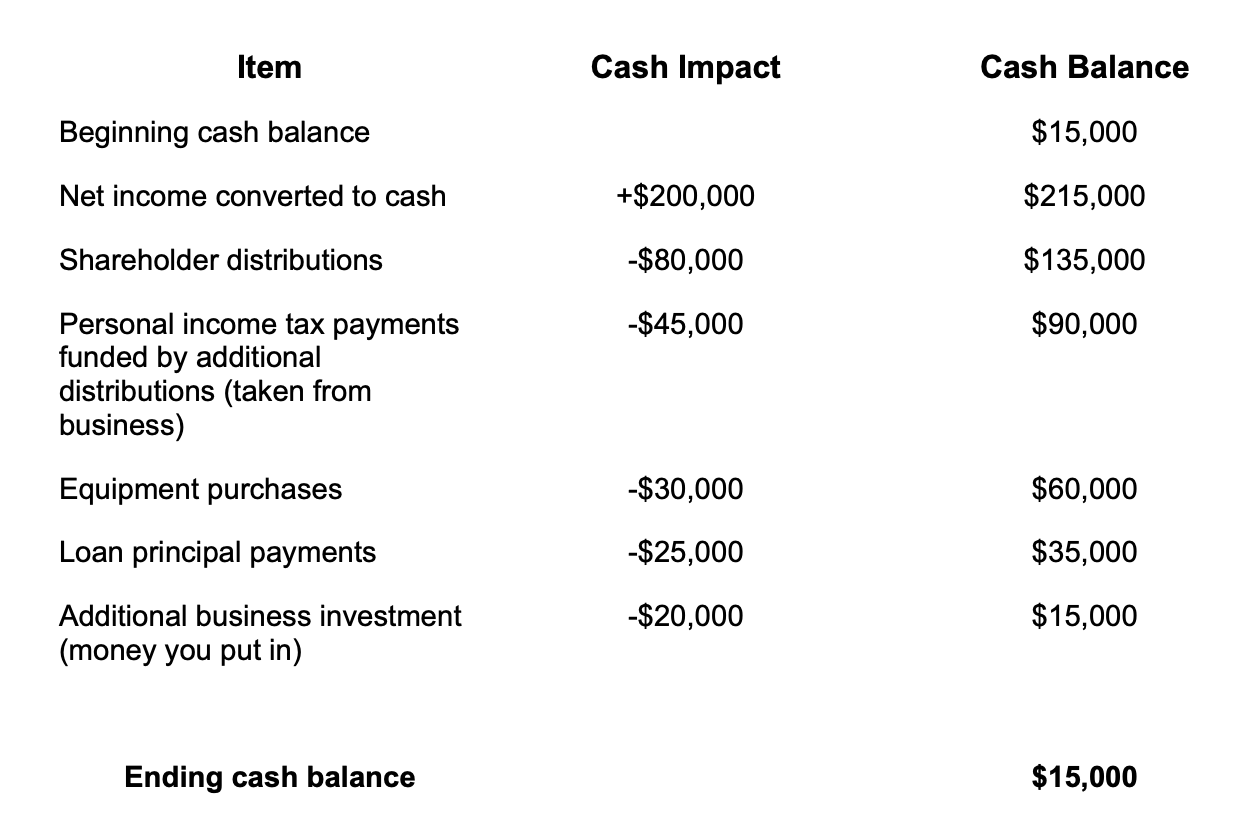
Note: For this example, the additional business investment represents a cash outflow for a capitalized asset or similar investment, rather than an expense already included in net income.
Your financial statements still report $200,000 in profit. Yet your business ends the year with only $15,000 in the bank.
Nothing necessarily went wrong. The money was simply used in ways that aren't fully reflected in your P&L. This is where planning for your taxes is important!
Of course, not every business has the same cash flow pattern. Accounts receivable, inventory, unpaid bills and other balance sheet changes can also create differences between profit and cash.
So, what should business owners be doing?
Understanding where your cash goes is the first step toward making better financial decisions.
Here are a few practices we recommend:
Review more than just your P&L
Your P&L tells you whether the business is profitable. Your balance sheet helps you understand your assets, liabilities and equity. Your statement of cash flows helps explain how money moves through the business. Together, these reports provide a much more complete picture of your financial position.
Establish a cash reserve
Rather than distributing every available dollar, consider maintaining sufficient cash to cover operating expenses, taxes, payroll and unexpected costs. Sometimes you have to tell yourself no! The appropriate reserve depends on your business model, overhead and the consistency of your revenue.
Plan for taxes throughout the year
For pass-through business owners, taxes should be considered when evaluating how much money is actually available to spend. Regular tax projections can help you estimate your obligations and avoid unexpected tax bills.
Monitor owner distributions
Taking distributions isn't inherently a problem. However, owners should understand how those withdrawals affect the business's liquidity. A business can be highly profitable while consistently distributing more cash than it can comfortably afford.
Keep your accounting current
If your books are only updated once a year, you may not realize there's a cash flow issue until it becomes a problem. Maintaining accurate financial records throughout the year allows you to identify trends, monitor spending and make informed decisions before cash becomes tight.
Final thoughts: Profitability is only part of the picture
A business generating $200,000 in annual profit may be performing very well. But that doesn't necessarily mean it has $200,000 available to spend.
Owner distributions, taxes, debt payments, equipment purchases and other cash outflows can significantly reduce the money available in your business accounts. Understanding these differences is an important part of managing a financially healthy business.
The question shouldn't just be, "How much profit did my business make?"
It should also be, "Where is my cash going, and am I managing it effectively?"
Need a clearer picture of your business finances?
At Jon Acevedo, CPA, LLC, we work with small business owners to provide ongoing accounting, bookkeeping, tax planning and financial reporting services. Our goal is to help you understand not only how profitable your business is, but also how to manage your finances more effectively.
Whether you're looking to improve your accounting processes, better understand your cash flow or develop a proactive tax strategy, our team can help.
Schedule a consultation to discuss your business's accounting and tax needs!
Thank you for reading our blog! Here are some helpful deadlines and notes:
Key tax deadlines
Individuals
April 15 – Federal individual income tax return due (Form 1040)
October 15 – Extended individual filing deadline
Estimated tax payments
April 15 – 1st Quarter payment due
June 15 – 2nd Quarter payment due
September 15 – 3rd Quarter payment due
January 15 – 4th Quarter payment due (following year)
Businesses
March 15 – Partnerships (Form 1065) and S-Corporations (Form 1120-S) due
April 15 – C-Corporations (Form 1120) due
September 15 – Extended deadline for Partnerships and S-Corporations
October 15 – Extended deadline for C-Corporations
Important reminder
An extension provides additional time to file a tax return, but not additional time to pay. Any expected tax liability should generally be paid by the original due date to minimize penalties and interest.
Current clients
Please upload tax documents through the secure client portal whenever possible. Additionally, please do not send Social Security numbers, tax returns, or other sensitive information by email. If you received an IRS or state notice, please upload the complete notice, including all pages.
Submission of documents does not constitute completion of a tax return. We will contact you if additional information is needed.
Helpful links
